
REVIEW · WALKING TOURS
Honolulu Downtown Walking Tour
Honolulu downtown can feel like a hurry, but this walk slows it down. You get a local guide and a tight route through the political and cultural landmarks that explain how Hawaii became Hawaii, then how it changed again under outside pressure. It is designed for first-time visitors, history fans, and anyone who wants meaning fast.
What I love most is the way the tour turns major buildings into a clear timeline, starting at the King Kamehameha Statue and moving through the centers of monarchy and government. I also like that the storytelling is carried by real guides, with Susan earning standout praise for making the chronology feel human and easy to follow.
The main drawback to plan for is that it is heavy on standing and talking. The route is short, but the time is spent stopping often, so if you want nonstop walking like a workout, this may feel a bit talk-forward.
Key Things That Make This Downtown Honolulu Tour Worth Your Time
- Small-group pace that keeps it personal, with a maximum of 30 travelers
- Local-guided storytelling that connects Polynesian, Austronesian, and Hawaiian origins to later political change
- Focus on central landmarks so you get meaning without crossing the whole island
- Free entry at key stops listed on the tour, so your $5 goes to the guide, not tickets
- A short, easy walk radius that works well for limited time and most fitness levels
- Guides in logo shirts so you can find your group quickly at the meeting point
Why a Short Downtown Walk Explains Hawaii So Well
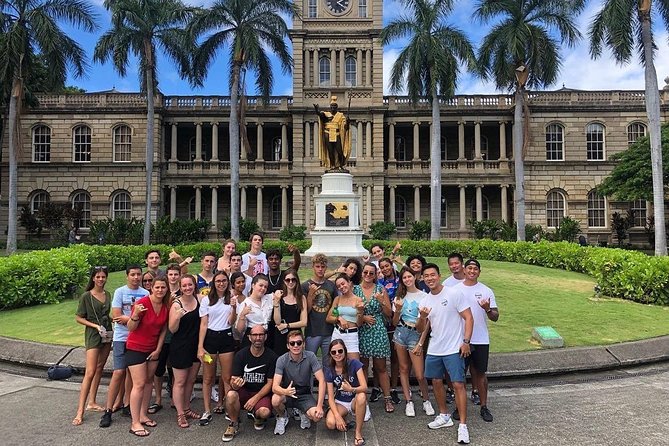
This is a “start here” kind of tour. Instead of trying to do everything in Honolulu, you get a guided thread through the heart of the city, with stops chosen for their role in governance, monarchy, and cultural identity.
The best part is that the tour is not just about what the buildings look like. You learn what they represented at different moments. That turns Honolulu into something you can read with your eyes, even after the walk ends.
And for value, $5 per person for a guided history walk is rare. You are paying for interpretation: how to connect events, explain power shifts, and point out what matters when you are surrounded by monuments and streets that look ordinary until someone tells you the story.
You can also read our reviews of more walking tours in Oahu



Meet at King Kamehameha Statue, Then Get Oriented Fast
You meet in front of the King Kamehameha Statue at 447 S. King St., Honolulu. The meeting point is right around the downtown core, and the tour notes you are outside Waikiki. That is a good thing. You get local context without the resort bubble.
The start time is 9:00 am, and you end back at the starting area. Your guide(s) wear a white or black t-shirt with the Hawaii Free Tour logo, so matching up is straightforward.
Two practical wins here. First, it is near public transportation, so you can build it into a day that also includes buses, rideshares, or other sightseeing. Second, you get a mobile ticket, and you receive confirmation at booking.
Group size matters too. With a cap of 30 travelers, you can usually hear the guide, and questions tend to land without turning into a chaos line.
Stop 1: King Kamehameha Statue and the Big Idea of a Unified Nation
The tour starts with one of the most recognizable symbols in Honolulu. But it is not a quick photo moment. The guide sets up the larger story first, including background on the roots of Polynesians and Austronesians, then moving toward Hawaiian formation of a nation.
From there, the Kamehameha theme becomes more than a name. The guide frames how unification under Kamehameha shaped what came next. You get context before you arrive at the buildings that represent power structures, courts, and state decisions.
What you should expect:
- A guided explanation right at the monument
- Enough time to look around the area, not just march through
Possible drawback:
- If you hate “waiting for the speech,” be aware that this stop begins your standing time. It is worth it if you like learning from the ground up.
Aliiolani Hale: Quick Context While You Stay in the Center
Between the early landmark and the palace, you pass Aliiolani Hale. The tour includes it as a distinct stop, which usually means your guide uses it as a connector in the story, not just background scenery.
Think of this portion as the tour tightening its focus. You are moving from the broad origins and unification theme toward the era of monarchs, buildings associated with royal and government authority, and the changes that followed when outside powers became central players.
If you are the type who likes to understand why a specific building sits where it does in the political story, this stop helps.
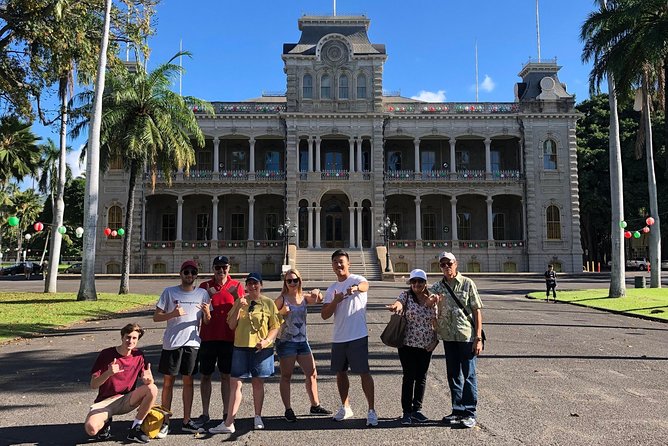
Stop 2: Iolani Palace and the Push-Pull of Monarchs and Outsiders
Next comes the Iolani Palace, and the emphasis is on leadership and influence. You will talk through different monarchs and how Europeans and people from the US mainland played a role in shaping Hawaii’s history.
This is where the tour starts to feel like a real timeline. The palace is not only a gorgeous site, it is also a symbol. The guide uses that symbolism to explain power transitions and the pressure Hawaii faced during periods of outside involvement.
What I like about this stop is how it helps you read the era. Once you understand who held influence and how it shifted, other details around downtown start to make sense.
What you should plan for:
- Another short guided segment where you take in the building from the outside and learn how it fits into the broader story
- Time to ask questions if you are curious about specifics
If you are a first-time visitor, this is one of the best places to anchor your understanding of what you are seeing.






Stop 3: Hawaii State Capitol and the Path From Territory to Statehood
Then you reach the Hawaii State Capitol. Here the tour focuses on the process of Hawaii becoming a US territory and later becoming a US state.
This is one of those moments where downtown history stops being abstract. The guide ties the story to the structures you are walking past. You stop seeing government buildings as random architecture and start understanding why they exist and what period they represent.
This is also a good place for photos if you like pictures with meaning. You are not just snapping a landmark, you are capturing the location tied to a major political transition.
A consideration:
- Because the walk is short, the guide likely spends more time at each stop to explain the transition clearly. That makes it talk-heavy compared with a self-paced stroll, but it also makes it easier to retain.
Stop 4: Kawaiaha’o Church and Faith as Historical Continuity
The tour includes Kawaiaha’o Church for about 10 minutes. Even in a shorter stop, the guide connects the site to the larger human story of Hawaii through time, with the emphasis on continuity.
Churches like this can seem like a quiet side note if you only think in dates and rulers. But when a guide places it in context, you start to see religious institutions as part of how communities held identity and structure through change.
You will likely get:
- A focused explanation that fits the tour’s storyline
- Time to observe and then move on before the group spreads out
This is also one of the stops where a short pause can feel like relief, especially if your morning is already heavy with sun, or if the weather is doing its thing. (The tour also states it depends on good weather.)
Downtown Government Stops: City Hall and the State Library
As you continue, the route includes Honolulu City Hall and the Hawaii State Library. These stops round out the story by showing the everyday face of government and public institutions.
Unlike monuments tied to a single person, city and state buildings represent systems. That is a useful shift. It helps you understand how history becomes ongoing administration, not just a chapter in a book.
You can expect your guide to use these stops as practical anchors:
- What each area signals about civic life
- How these institutions fit into Hawaii’s modern structure
If you are traveling with limited time, these stops are a smart way to see the “now” without ignoring the past.
Stop 5: King Lunalilo Mausoleum for Monarchy Legacy in a Garden Setting
The final main stop is the King Lunalilo Mausoleum, including time for the garden and burial area, around 15 minutes.
This stop changes the mood from politics to legacy. It is one thing to hear about monarchs in a timeline and another to stand somewhere designed as a lasting resting place. The guide’s storytelling here helps you understand why these sites matter to memory, not just to sightseeing.
What I find valuable is that the tour ends on a quieter note. After walking through government buildings and political transitions, it helps you absorb the story as something grounded in real lives.
Practical note:
- Plan for standing and slow movement. If your legs get tired easily, this is still manageable, but you will be on your feet for much of the morning.
How Much Walking Is It, Really, and What That Means for You
The tour duration is about 1 hour 10 minutes. Some days it runs closer to 1h 20m, depending on pacing and questions.
The route stays concentrated. You are working around downtown in a tight radius, roughly within about 1.5 km of the main sights. One key point from the experience is that it may feel like very short walking but longer stopping time.
So here is the real expectation: you are doing a downtown stroll that doubles as a guided museum tour, with frequent “pause and explain” moments.
This makes it ideal if:
- You have limited time and want a strong overview
- You like asking questions while you are standing near the places being discussed
- You are visiting for the first time and want the downtown layout turned into a story
It may be less ideal if:
- You want a workout style walk with lots of continuous movement
- You get restless with extended standing segments
The Guide Makes the Difference, Especially When You Get Susan
This tour’s standout factor is the guide. Multiple people specifically praised Susan by name. Her style is described as warm, insightful, and clear, with a way of explaining Hawaiian history in plain language.
That matters because the subject can get complicated fast. The roots of Hawaiian identity, the monarchy timeline, and the shift toward US territory and statehood are not always easy to track on your own. A strong guide helps you keep the chronology straight.
I also like that questions are encouraged. You can ask about monarchs, European and mainland influence, or how the different phases connect. If you like learning by conversation, this will reward you.
Value Check: $5 for a Downtown History Thread
Let’s talk value honestly. The price is $5.00 per person. Most of the listed stops are noted as free admission for this tour, which means you are not paying extra to get into the key sights.
So what are you really buying? You are buying:
- Organization, so you do not miss the connections
- Interpretation, so you understand what you are looking at
- A small-group approach, so the walk stays interactive
Compared to paying for multiple separate attractions, this is a low-cost entry into a strong historical orientation. If you are budgeting in Honolulu, this is one of those “start smart” decisions.
Weather, Timing, and Comfort Tips for a Good Morning
The experience notes it requires good weather. That means you should check conditions close to departure, especially if you are planning other outdoor activities right after.
It is also a morning tour, starting at 9:00 am. Honolulu can move quickly from pleasant to hot, and downtown shade varies by block. I recommend:
- Wear comfortable walking shoes. Even if the walk is short, you stand often.
- Bring water. You are out for about a bit more than an hour.
- If you run late, try to communicate. The tour has enough of a rhythm that you do not want to arrive completely off-schedule.
Finally, since this is outside Waikiki, think about transit time when planning your morning.
Should You Book This Honolulu Downtown Walking Tour?
Yes, I think you should book it if you want a focused start to Honolulu. For $5, you get a structured story across major sites tied to monarchy, government, and the shift into the US political timeline.
Book it especially if:
- You are short on time and want the downtown core explained
- You like history that connects people to places
- You prefer guidance over self-guided guessing
Skip it if you want mostly movement. The walk is short, and the experience leans heavily on guided talking and standing.
If you can handle that trade-off, this is a smart, budget-friendly way to leave downtown with more than photos. You will leave with a map in your head. And once you have that, Honolulu makes a lot more sense.
FAQ
What is the duration of the Honolulu Downtown Walking Tour?
It lasts about 1 hour 10 minutes (approx.), with some days running a little longer depending on pacing and questions.
How much does the tour cost?
The price is $5.00 per person.
Where do I meet the tour?
Meet in front of the King Kamehameha Statue at 447 S. King St., Honolulu, HI 96813. The meeting time listed is 9:00 am.
What landmarks will we visit?
You will stop at King Kamehameha Statue, Aliiolani Hale, Iolani Palace, Hawaii State Capitol, Kawaiaha’o Church, Honolulu City Hall, Hawaii State Library, and King Lunalilo Mausoleum.
Is the admission included for the stops?
The stops listed for the tour include free admission, so you should not need to pay separate entry fees for the featured stops.
Is there a mobile ticket?
Yes. The tour uses a mobile ticket.
What happens if the weather is poor?
The experience requires good weather. If it is canceled due to poor weather, you will be offered a different date or a full refund.
Can I cancel and get a refund?
Yes. Free cancellation is available, and for a full refund you must cancel at least 24 hours before the experience’s start time.
More Walking Tours in Oahu




More Tours in Oahu




More Tour Reviews in Oahu

Not for you? Here's more nearby things to do in Oahu we have reviewed












Walking Tours, compared.
 ★ 4.5Self guided Hike Trail to Nature Walk & WaterfallFrom $79283 reviews
 ★ 4.2Honolulu Haunts: Ghosts and Spirits Walking TourFrom $27169 reviews
 ★ 4.0Kualoa Ranch – Horseback Walking TourFrom $173145 reviews
 ★ 4.5Ghosts of Old Honolulu Walking TourFrom $3553 reviews
 ★ 5.0Honolulu’s Walking Food TourFrom $12929 reviews
 ★ 3.5Downtown Honolulu Self Guided Walking Audio TourFrom $96 reviews
 ★ 4.0Honolulu Historic District a Smartphone Audio Walking TourFrom $106 reviews
 ★ 4.9Waikiki: Waikiki Night Marchers Ghostly Walking TourFrom $406 reviews
Browse the lists this tour appears in