REVIEW · HONOLULU HISTORY, PALACE & GHOST TOURS
Honolulu Historic District a Smartphone Audio Walking Tour
Honolulu history sounds good on a walk. This smartphone audio tour strings together major downtown landmarks with story-driven narration, from Aliʻiolani Hale to the Hawaii Theatre. I like the way the live GPS map keeps you on track, and I also like that you can slow down or skip ahead as you choose. One thing to watch: this is an audio walk, so don’t plan on paid entry to ticketed sites.
You start right at Aliʻiolani Hale, the House of the Heavenly Kings, and you move through a self-paced route built around kings, architecture, churches, and memorials. The whole experience runs about 1 to 2 hours, and it works 24/7 during the tour’s operating window, so you can fit it around sun, crowds, and your other plans. In English, the narration plays automatically at points of interest, and you download it first on WiFi so you are not relying on cell service outdoors.
The tour is designed for your group only, and the ticket is mobile. You will need a smartphone or tablet to play the audio, and if you do not use earbuds, the sound comes from your device speaker. If you are hoping for an inside palace visit, plan to do this as a walk-and-see experience outdoors, since attraction entry tickets are not part of the tour.
Key highlights worth planning around

- Live GPS route guidance helps you stay oriented downtown without constantly checking your phone screen.
- Auto-playing narration at each stop turns a simple walk into an information loop that is easy to follow.
- A timeline built from power and place connects Hawaiian monarchy, architecture, and civic buildings into one route.
- Lots of short viewing moments means you can pause, read, and move on at your own pace.
- Earbuds make a difference since some audio can be quiet if you rely on the speaker.
Walking Honolulu’s downtown power centers from Aliʻiolani Hale

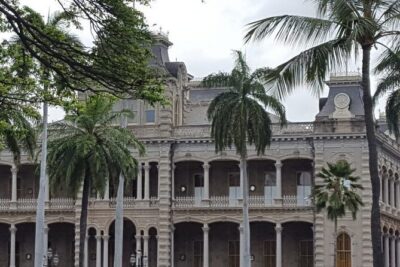
Downtown Honolulu can feel like it is all together, until you start walking with a story in your ear. That is what this tour does well. You begin at Aliʻiolani Hale, 417 S King St, a fitting start because it anchors the whole route in Hawaiian political life. Even if you are not a hardcore history person, the narration gives you the names and context quickly, so the buildings stop being random and start feeling intentional.
A big part of why this walk works is the mix of scales. Some stops are about a single figure or a specific structure, like the building associated with King Kalakaua or the statue of King Kamehameha I. Other stops are about what civic Honolulu became, including municipal and cultural institutions that shaped daily life. That balance helps you keep interest even when one stop is more scenic than another.
You also get a clear rhythm. The audio plays when you reach each point, so you do not have to constantly read signs or guess what you are looking at. And because you are not on a rigid time schedule, you can wait for the right moment to take photos or just step out of traffic flow for a minute.
You can also read our reviews of more walking tours in Oahu
Price and timing: a $10.99 self-paced loop

At $10.99 per person for a 1 to 2 hour walk, this is priced like a budget-friendly activity that works even if your day plan is loose. The real value is not the quantity of stops alone. It is the convenience of having an organized path through a compact area, plus story narration that makes each stop mean something.
Another practical plus: the tour is flexible, with flexible dates and the idea that you can enjoy it anytime on Tripvia Tours. That matters in Honolulu, where weather can shift fast and plans change. If you get your timing wrong, you do not have to abandon the whole idea. You can reslot it.
On timing, I would treat this as a half-day add-on. It fits nicely before lunch, or in the late morning when the streets are active but you are still fresh. Since you return to the start point, you can also wrap it up and keep exploring the area on foot without feeling stuck with an ending you must rush to meet.
How the smartphone audio works (and how to avoid the common pitfalls)
This tour is built around your phone. You download the tour on WiFi before you go, and then during the walk there is no signal required and no data used. That is a relief in downtown, where connectivity can be inconsistent. It also means you can focus on walking instead of chasing a loading screen.
Once you are at the start, the tour ticket lives on your mobile device. The audio is offered in English and is designed to play automatically at each point of interest. You also get a live GPS map showing your route and your location. That is the best combo for a self-guided walk: you are not guessing your turns, and you are not stuck staring at directions.
Two practical notes. First, headphones are optional. Audio will play from your device speaker too, but you will likely get better clarity with earbuds, especially if you are near traffic noise or if the audio volume feels subtle. Second, smartphone or tablet is required. This is not one of those tours where you can borrow a device at the start.
Stop-by-stop: what you will see and what to listen for

Below is the flow you will follow, with the key idea of what each stop adds. Think of this as an orientation cheat sheet, so you know what the audio is preparing you to notice.
Aliʻiolani Hale and King Kalakaua’s 1879 connection
You kick off at Aliʻiolani Hale, known as the House of the Heavenly Kings. The narration ties it to King Kalakaua, built in 1879. Even if you only glance at the building, it helps to know this is not just architecture, it is a marker of monarchy-era power and identity.
What to listen for: why this structure matters in the story of Hawaii’s leadership. If you are walking with someone else, this is a good stop to pause a moment and talk through the names you hear, since the audio builds from here.
You can also read our reviews of more historical tours in Oahu
King Kamehameha I statue and the folklore thread
Next comes King Kamehameha I. The tour uses his statue as an anchor for folklore and the deeper legend around the most celebrated monarch. When an audio tour introduces a king this early, it sets a tone for the rest of the walk. You start hearing about decisions, legacies, and symbolism, not just dates.
Kanaina Building, Victorian details, and national recognition
Then you reach the Kanaina Building, noted as an important example of Victorian architecture in Hawaii and added to the National Register of Historic Places in 1978. This is where the tour shifts from monarchy to style and preservation. If you like noticing building features, this is a stop you can slow down for.
What to watch: the shape and style of the structure, and the way it contrasts with what you might expect in Hawaii. The audio gives you the why behind the label Victorian.
Patsy’s statue and why it exists
A stop tied to Patsy focuses on her accomplishments and the reason a statue was created. This is a quick but meaningful pivot. It reminds you Honolulu is not only made of royal-era landmarks. It is also shaped by civic life and the people later generations honored.
A reading room that aimed to keep sailors out of trouble
You then move to a book-lover themed stop. The narration explains this “haven for book lovers” started as a reading room established in 1879, with a purpose that was practical and a little humorous in tone, keeping unruly sailors out of mischief.
If you like human-scale stories, this is a great moment. It takes you away from grand politics and puts you into everyday social life, where even a reading room has a mission.
Hawaii’s oldest church
Next is a church stop, presented as Hawaii’s oldest church. This kind of stop is valuable because it adds a different kind of history. It is not only about who ruled, but also about faith, community building, and long-term institutions.
King Lunalilo and the Royal Mausoleum question
The tour then tells the story of King Lunalilo and why he refused to be interred in the Royal Mausoleum, choosing instead burial here. This is one of those moments where you learn that tradition is not automatic. Decisions are personal, and the audio uses that to explain why the site looks the way it does in the larger story.
City hall building, a construction timeline puzzle, and engraved years
After that you get the city hall building and its impressive features, plus a bit of a mystery. The audio addresses why the years 1820 and 1915 are engraved on the front even though the building was constructed in 1921. This is the sort of detail that makes you look twice at the facade instead of walking past it.
How to enjoy it: stand still for a minute and actually read what is on the front. The audio makes the engraving feel like a message, not just decoration.
The weird-looking sculpture and a natural phenomenon
Then comes the story behind a weird-looking sculpture and how it connects to a natural phenomenon. This is a fun stop because it breaks the pattern of royalty and civic buildings with something more unexpected. If you enjoy weird local details, this is one you will probably remember after the walk ends.
Frank F. Fasi Building, design quirks, and 2006 municipal shift
As of 2006, the route includes the Frank F Fasi Building, described as Honolulu’s new municipal Building at that point, with a unique design and narration explaining the reason. This stop matters because it brings the timeline into modern civic life.
It is easy to visit downtown and only think of the old. This section nudges you to notice that Honolulu continues to rewrite its own story with new institutions and new architectural choices.
Seagull Schools grounds and the stone figures
Next are relaxed-looking stone folks located on the grounds for Seagull Schools, an early childhood education center. This is a softer, more local-feeling stop. You are not only walking through monuments, you are passing educational spaces where community life continues.
Honolulu Police Department uniqueness
Then the audio shares something unique about the Honolulu Police Department, explained as part of the grounds and surrounding features. I like stops like this because they add practical present-day context without turning into a lecture. It helps you see the downtown area as an active system, not just a museum district.
Bell of Nagasaki: peace and US-Japan friendship
A highlight for meaning is the Bell of Nagasaki, described as a symbol of peace and friendship between the United States and Japan. Even if you are just passing through, you will get a strong emotional read from this one. It also gives the tour an international angle, not just an island-focused one.
Queen’s Conference Center and the path to Hawaii State Capitol
Next is the Queen’s Conference Center, described as a historic and cultural landmark. The audio connects it to Queen Emma and King Kamehameha IV and their vision. Then, in 1969, this remarkable building officially became Hawaii State Capitol, with details shared by the narration.
This section is valuable because it ties monarchy-era ideas to later governance structures. You are watching the site change roles across time, and the audio helps you keep track of why that matters.
The regal manor built in 1842 by a clipper ship captain
Another big timeline jump comes with a regal manor built in 1842 by a clipper ship captain for his wife and young son. The audio presents its tale. This stop helps explain how Honolulu’s story was shaped by trade, travel, and people arriving by sea, not only by local ruling families.
A museum dedicated to Hawaii art and culture
The route then includes a museum stop, dedicated to showcasing the art and culture of Hawaii. The audio frames it as a must-see destination if you want traditions and local creativity. Since attraction tickets are not included, you may or may not go inside during your walk, but even the exterior and the narration help you decide if you want to schedule more time.
The Kamehameha dynasty and a Queen’s voice
After that, you hear what the Queen herself could have said, referencing her as the last surviving member of the Kamehameha dynasty. This is another meaning-heavy stop. It turns a historical endpoint into a human voice, which makes the timeline land harder.
A place of worship dreamed up by King Kamehameha and Queen Emma
Then you visit a magnificent place of worship that was a dream of King Kamehameha and Queen Emma. This is the tour reinforcing the same theme from different angles: power, then legacy, then faith, then physical sites you can still stand near today.
Queen Emma area name changes, now shared with James and Abigail Campbell
Next is a named area connected to Queen Emma. The narration notes that as of 2016, the honour is shared with James and Abigail Campbell. This is a small but important civic-history detail. Names change because people want history to reflect more voices over time.
The pedestrian street mall for downtown energy
You then head into a pedestrian-only street mall established in the 1960s to revitalize downtown. The audio frames it as a continuing popular destination for shopping, dining, and entertainment. This part is useful because it changes your tempo. After monuments and memorials, a street mall lets you reset, eat, browse, and decide what you want next.
Hawaii Theatre Center, 1922 vaudeville and silent films
The Hawaii Theatre Center opened in 1922, and the audio ties it to vaudeville and silent film. Even if you just walk past, the narration helps you see the building as entertainment infrastructure, not only as a pretty facade.
Kumu Kahua Theatre Company donation and new works
The building was donated to the Kumu Kahua Theatre Company, with a goal of producing new works by Hawaii playwrights and works reflecting diverse cultures and experiences. This stop is one of the tour’s best switches from past to creative present. It connects history to ongoing theatre work.
Replacing bricks, what they chose instead
The tour ends with a story about substitutions for the bricks newcomers were accustomed to building with back home, and it explains what they decided on. This is a closing detail that brings you back to a practical theme: building methods and adaptation in Hawaii.
Earbuds, pacing, and how to make the tour feel personal

One of the strongest things about this tour format is control. You can take as long as you like to complete it, and there are no time constraints pushing you from one stop to the next. That is great if you want a slower pace, or if you stop often to read plaques.
The audio also gives you an easy way to skip. If you arrive at a stop and it feels less interesting to you in the moment, you can move along and not feel like you failed the tour. This is a self-guided style, so your goal is to walk the route in a way that fits your interests.
For audio quality, I strongly recommend earbuds. If you depend on your device speaker, traffic noise and street activity can swallow some narration. Even if the audio plays automatically, having a tighter listening setup makes it feel more like an intentional guided experience.
A final pacing tip: expect some stops to be more visually striking than others. That is normal for any downtown walking route. The good news is that the tour is built so you still get meaning from stops that are more informational than scenic.
Who should book this Honolulu historic audio walk?

This tour fits best if you want a low-cost way to understand downtown Honolulu without hiring a private guide. At 1 to 2 hours, it works for first-time visitors who want names, key stories, and context while walking between well-known landmarks.
It is also a good option if you like flexibility. You can fit it around weather, and since the audio can be downloaded beforehand using WiFi with no data needed, it is easier to keep the experience smooth outdoors. English narration helps too, and the audio plays automatically so you are not constantly tapping.
If your priority is inside museum time or palace entry with paid admission, you will need to plan that separately. Attraction tickets are not included, so use this walk as the context builder, then add the ticketed experiences you care about most.
Should you book this Honolulu Historic District smartphone audio tour?

I think you should book it if you want an affordable, well-structured way to understand downtown Honolulu fast, without being stuck on a schedule. The combination of live GPS, auto-playing narration, and a route that moves through monarchy sites, civic buildings, churches, memorial symbolism, and theatre culture is a strong value mix for $10.99.
I would skip booking or adjust expectations if you are mainly chasing paid entry into specific buildings, because attraction tickets are not included. In that case, this still can work as your warm-up walk, but you should pair it with extra plans for any interior stops you want.
If you are the type who likes to walk, listen, and learn while your legs do the work, this is a smart buy and a convenient way to see Honolulu in a couple focused hours.
More Walking Tours in Oahu
More Tours in Oahu
More Tour Reviews in Oahu
Not for you? Here's more nearby things to do in Oahu we have reviewed
Honolulu History, Palace & Ghost Tours, compared.
★ 4.5Bishop Museum General Admission TicketFrom $38243 reviews
★ 4.5Honolulu Haunts and Hauntings Ghost TourFrom $32170 reviews
★ 5.0Historical Honolulu Bike TourFrom $14976 reviews
★ 5.0Waikiki Night Marchers Ghost TourFrom $3564 reviews
★ 5.0Downtown Honolulu Food Tour with 5 Local Favorites TastingsFrom $10754 reviews
★ 5.0Honolulu Night Marchers Ghost TourFrom $3526 reviews
★ 4.7Honolulu: Bishop Museum General Admission TicketFrom $3820 reviews
★ 4.0Waikiki Ghost Tour: Torches & TerrorsFrom $3216 reviews
Browse the lists this tour appears in